

Blog
Black Tourmaline: History, Science, Lore and Care

Black tourmaline is the deep black member of the tourmaline family, a group of minerals famous for its wide range of colors. In crystal lore it is one of the best-known stones of all. In this article we explore black tourmaline from every side: its history, its physical character and the science behind it, its place in crystal lore, how it appears in meditation and ritual, and how to care for it. Traditional associations are shared as culture and folklore; this is not a substitute for medical care.
The History of Black Tourmaline: A Stone of Steadiness
In crystal lore, black tourmaline has long been associated with balance and steadiness. Tourmaline as a whole has been traded and worn for centuries, and it appears in the traditions and rituals of several cultures.
- Historical Use: The name tourmaline comes from the Sinhalese word turamali, used in Sri Lanka for mixed, colorful gem pebbles. Dutch traders brought tourmaline from Sri Lanka to Europe around 1700. In folklore, dark stones such as black tourmaline were often carried as charms, and in modern crystal traditions black tourmaline is one of the most popular stones for grounding and inner calm.
- Cultural Significance: In many modern traditions, black tourmaline is regarded as a stone of steadiness and self-possession. It appears in Eastern meditation practice and in Western crystal traditions alike. Because the tourmaline family comes in so many colors, chakra lore pairs its different colors with different chakras, and black tourmaline with the root chakra.
Tourmaline’s story reaches from Sri Lanka and the spice trade to European courts and modern mines in Brazil, Africa and Afghanistan. In each culture it has taken on different meanings. In the Chinese imperial court of the 19th century, pink and red tourmaline were carved into snuff bottles and jewelry, and Empress Dowager Cixi was famously fond of it.
The science of tourmaline is just as fascinating. In the 18th century, scientists found that tourmaline crystals become electrically charged when they are heated or cooled, a property called pyroelectricity. Dutch traders had already noticed that a warm tourmaline would pull light ash toward it. In 1880, Pierre and Jacques Curie showed that tourmaline also produces a charge when it is squeezed, called piezoelectricity. These discoveries made tourmaline a subject of real scientific interest, alongside its long life in folklore.
Astrological Connections: Black Tourmaline and the Zodiac
In astrological lore, black tourmaline is associated with the signs Libra, Scorpio and Capricorn. In this tradition, it is said to suit the character of each sign and to be a companion for finding balance.
- Zodiac Associations: For Libra, black tourmaline is associated with the sign’s search for fairness and harmony. For Scorpio, it is linked with making sense of deep, complex emotions. For Capricorn, it is associated with focus, discipline and determination in the face of challenges.
- Astrological Lore: In astrological tradition, black tourmaline is associated with inner strength and a feeling of security. Those who follow this tradition like to keep it as a reminder to trust their own judgment and intuition.
These astrological associations have given black tourmaline a place in many people’s personal rituals. For those who follow astrology, it is a stone linked with the traits of each of its three signs and with the idea of personal growth.
With the growing popularity of astrology and crystal lore in recent years, stones like black tourmaline have drawn new attention. For many people, its astrological associations are part of its appeal, alongside its striking look.
For astrology enthusiasts, black tourmaline is more than an accessory or a decorative object: it is a small, meaningful companion for their inner journey. Its connection with Libra, Scorpio and Capricorn is a rich subject for anyone who enjoys astrology and crystal lore, and a good starting point for learning more.
Cleaning and Caring for Black Tourmaline
Black tourmaline is a relatively hard stone, around 7 to 7.5 on the Mohs scale, which makes it durable enough for everyday jewelry and decor. Still, a little care keeps its glassy shine. Here are some tips:
- Gentle Cleaning: Clean black tourmaline with lukewarm water, a drop of mild soap and a soft cloth or soft brush, then rinse and dry it well. Avoid harsh chemicals and abrasives, which can dull the surface. Raw crystals with natural grooves can be cleaned with a soft toothbrush.
- Storage: Keep black tourmaline away from extreme heat and sudden temperature changes, which can cause cracks. To avoid scratches, store it apart from other jewelry and hard objects, ideally in a jewelry box or a soft stone pouch.
With this simple care, black tourmaline keeps its natural beauty for many years. In crystal tradition, some people also set their stones in moonlight or pass them through incense smoke as a small ritual of renewal; these customs are shared as tradition, not as promises.
The Character of Black Tourmaline: Form and Lore
Black tourmaline stands out for both its physical form and its place in crystal tradition. Here is a closer look at each.
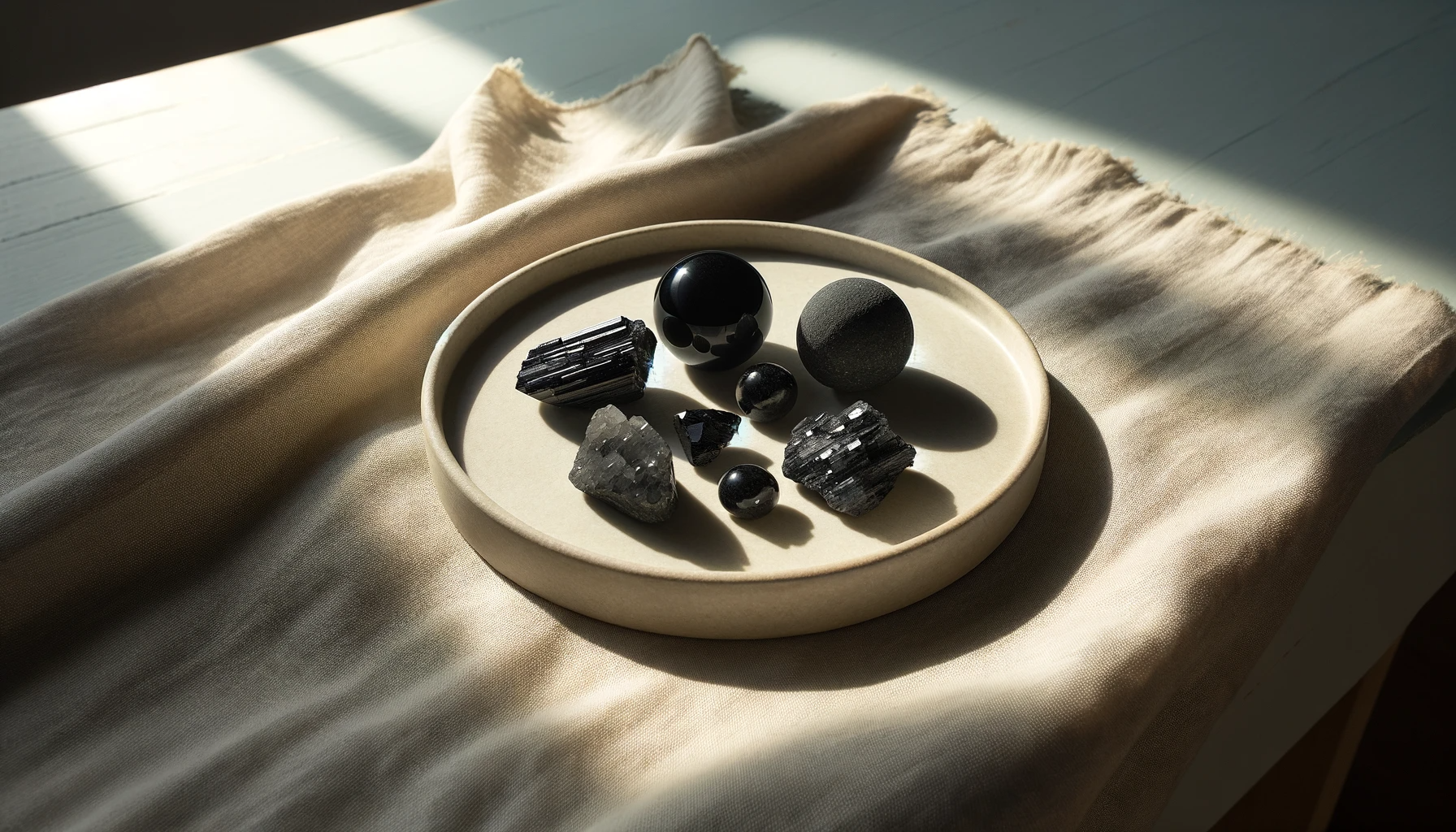
- Physical Appearance: Black tourmaline, known to mineralogists as schorl, is an iron-rich boron silicate. It is opaque, with a shiny, glass-like surface, and its deep black color comes from its iron content. It usually forms long, prismatic crystals with fine vertical grooves and a rounded triangular cross-section, which makes raw pieces easy to recognize.
- Traditional Associations: In crystal lore, black tourmaline is associated with grounding, steadiness and a feeling of security. Many people like to keep it nearby during busy days as a symbol of calm, and it is also associated in these traditions with clarity and focus.
Black tourmaline is found in granite and pegmatite rocks around the world, often alongside quartz and mica. Some of the most striking specimens are black crystals set in white quartz, known as tourmalinated quartz when fine needles of tourmaline grow inside clear quartz. Raw pieces are usually sold as natural rods or chunks, while tumbled stones are smoothed and polished; both show the same deep black color, though polished stones have a brighter shine.
These qualities make black tourmaline popular with jewelry makers and crystal collectors alike. Its dark, glossy look and its place in crystal lore have made it one of the most recognized stones in modern crystal traditions.
Black Tourmaline in Meditation and Ritual
Black tourmaline is a stone often chosen for meditation and ritual. In crystal lore it is known for a sense of steadiness, and many people like to include it in their practice. Here is how it is traditionally used:
- During Meditation: In crystal lore, black tourmaline is associated with clarity and inner calm. Many people place it in their meditation space or hold it in their hand as a focal point. Because it is traditionally linked with the root chakra, some like to rest it on the floor in front of them or hold it low, as a reminder to feel their connection with the ground beneath them.
- Ritual Practice: In crystal traditions, black tourmaline often appears in rituals that mark a fresh start: a move, a new job or the end of a difficult season. Some people place a stone near the front door or in the corners of a room as a symbol of a calm, settled home. It is also a popular stone to keep on a desk or bedside table as a reminder of an intention.
For many people, black tourmaline has become a familiar part of meditation and ritual. As a symbol of steadiness and calm, it is a meaningful object to return to, and a good way into the wider world of crystal lore.
Black Tourmaline and the Chakras
In chakra lore, black tourmaline is associated in particular with the root chakra, and in some traditions also with the heart chakra. Here are those associations:
- Root Chakra: In chakra tradition, the root chakra sits at the base of the spine and is linked with safety, stability and basic needs. Black tourmaline is one of the stones most often paired with it, as a symbol of being grounded and secure. It is also associated in this lore with a sense of connection to the earth.
- Heart Chakra: In some traditions, black tourmaline is also associated with the heart chakra, which chakra lore links with love, compassion and emotional balance. In these traditions, it is a symbol of letting go of old hurts and making room for understanding and patience, toward ourselves and others.
These associations give black tourmaline an important place in chakra tradition. For those interested in chakras, it is a good stone to begin with, and a doorway into learning more about this old system of ideas.
Black Tourmaline in Culture and Myth
Tourmaline has been treasured in many cultures, and black tourmaline in particular has become a symbol of steadiness and quiet strength.
- Stories and Beliefs: In folk traditions of several regions, dark stones were carried as charms, and black tourmaline was among them. In European folklore, black stones were often worn as charms and keepsakes, according to tradition. In parts of Asia, tourmaline was used as a focal point in meditation and spiritual practice.
- Cultural Significance: The many colors of the tourmaline family have taken on different meanings in different cultures. Black has often stood for strength, depth and wisdom, and black tourmaline’s glossy, dark crystals have inspired jewelers, artists and writers.
These cultural stories lift black tourmaline beyond a physical object. How different societies have valued it shows how people have always looked to the natural world for symbols, and it is a rich subject for anyone interested in folklore and crystal traditions.
Bring the Look and Lore of Black Tourmaline into Your Life
Black tourmaline, a stone rich in history and folklore, is a striking way to add both beauty and meaning to your space. Discover the glossy black crystals of the Black Tourmaline Stone on our website.
Related Products and Other Crystals
Alongside black tourmaline, explore our Crystal / Natural Stone collection to discover other stones with their own traditional associations and lore. Each stone has its own color, form and story, and you can find your favorites on our website.
Traditional associations are shared as culture and folklore; this is not a substitute for medical care.




