
Blog
Beeswax vs Soy vs Paraffin Candles: What Is the Difference?

Last updated: 2026-11-03 · Mamuxa atelier, Anatolia
Beeswax is made by honeybees, soy wax is made from soybean oil, and paraffin is a by-product of refining crude oil. Beeswax melts at the highest temperature of the three, so it can stand on its own as a pillar; soy wax is softer and is mostly poured into jars. According to the National Candle Association, no single wax is “best,” and no wax is soot-free. How a candle burns depends as much on the wick and how you care for it as on the wax.
Where each wax comes from
Beeswax. Young worker bees make wax in small glands on the underside of their abdomen and use it to build honeycomb. Beekeepers collect it, melt it and clean it. It was the main candle material for centuries, until cheaper petroleum-based paraffin came along.
Soy wax. Soy wax is made by hydrogenating soybean oil, a process that turns the liquid oil into a solid. Soy and palm waxes came into commercial candle making in the late 1990s.
Paraffin. Paraffin wax is a by-product of refining crude oil. It comes in many grades and blends.
The comparison at a glance
| Beeswax | Soy wax | Paraffin | |
|---|---|---|---|
| Source | Made by honeybees | Hydrogenated soybean oil | Crude oil refining |
| Typical melting point | 144–149°F (62–65°C) | about 100–125°F, depending on the blend | about 118–154°F (48–68°C), depending on the grade |
| Typical format | Pillars, tapers, hand-rolled candles | Jars and tins, tealights | Pillars, jars, tapers |
| Scent | Its own natural, sweet honey-like scent | Holds added fragrance | Holds added fragrance well |
| Surface over time | A soft white “bloom” can form | Can show “frosting” crystals | — |
Melting points vary with the exact wax and blend, so treat these as typical ranges, not fixed numbers.
Why melting point matters
A wax that melts at a higher temperature stays firm in a warm room. That is why beeswax can be shaped into free-standing pillars and hand-rolled candles that keep their form. Candle-supply makers note that a pillar needs a wax that melts at around 135°F or higher, which is why most soy wax ends up in jars, where the container holds the melted wax.
Scent: natural or added
Beeswax has a light, naturally sweet scent of its own. Our beeswax candles have no added fragrance; what you smell is the wax itself. Soy and paraffin are usually chosen when a maker wants to add fragrance oils, and paraffin in particular holds added scent well.
If you enjoy a strong, room-filling fragrance, a scented soy or paraffin candle will give you that. If you prefer a quiet, natural warmth, beeswax is the gentler choice.
What about soot?
This is where you will read the boldest claims online, so it is worth being careful. The National Candle Association states that there is no such thing as a soot-free wax, and that well-made candles of any wax burn in much the same way. Research on candle emissions exists, but results differ between studies, and several were funded by one part of the industry or another.
What makes the most practical difference is how you burn the candle:
- Trim the wick to 1/4 inch before every lighting.
- Keep the candle away from drafts, fans and open windows; a flickering flame smokes more.
- Burn for no more than four hours at a time.
Our first-burn guide walks through each step for beeswax candles.
A note on labels
“Soy candle” does not always mean 100% soy. Candle-supply makers sell soy waxes blended with paraffin and other additives. If the exact wax matters to you, check the label or ask the maker. Our candles are made from 100% pure beeswax with a cotton wick, with no paraffin, artificial dyes or synthetic fragrances.
How to choose
- Choose beeswax if you like free-standing pillars, a natural golden color and a subtle, natural scent.
- Choose soy if you want a jar candle with an added fragrance.
- Choose paraffin if you want a strong scent throw at a lower price.
Whatever you choose, safe burning is the same: never leave a candle unattended, keep it at least 12 inches from anything that can catch fire, and keep it out of reach of children and pets.
What you’ll need
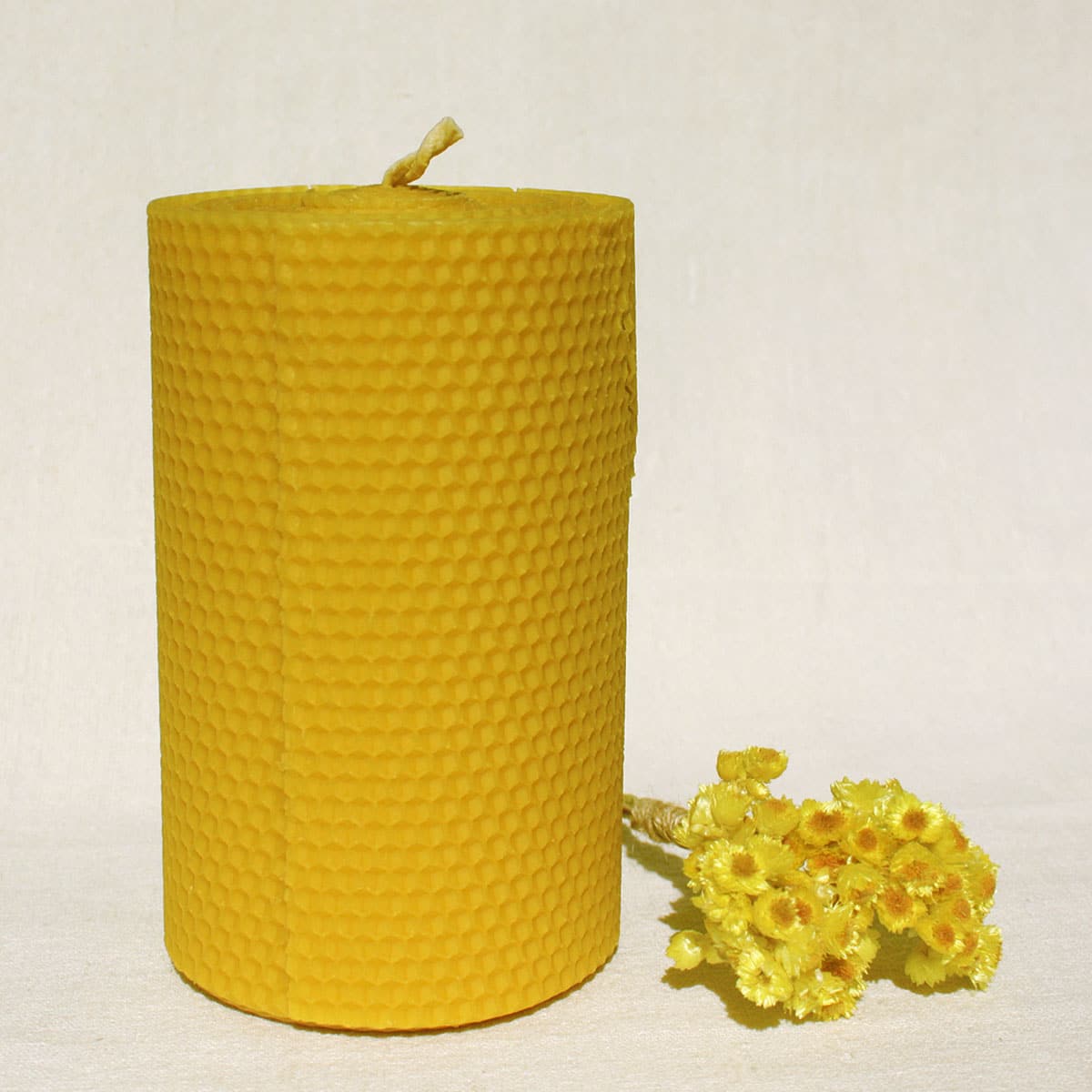
- A beeswax candle from our candle collection, such as the Large Beeswax Candle, 10 x 15 cm or Beeswax Candle Set No.1
- A heat-resistant candle holder or plate
- Small scissors or a wick trimmer
FAQ
Which candle wax is best?
There is no single best wax. Beeswax suits pillars and a natural scent, soy suits scented jar candles, and paraffin holds added fragrance well at a lower price. Choose by the format and scent you want.
Is beeswax better than soy?
They are different rather than better or worse. Beeswax melts at a higher temperature and can stand as a pillar with its own natural scent; soy is softer and usually poured into jars with added fragrance.
Do beeswax candles make soot?
Every candle can make some soot. The National Candle Association says no wax is soot-free. Trimming the wick to 1/4 inch and keeping the candle out of drafts makes the biggest difference.
Why does my beeswax candle have a white coating?
That is bloom, tiny wax crystals that form on the surface over time. Warm the candle with your hands and polish it with a soft cloth to bring back the golden color.
Do your beeswax candles have added fragrance?
No. Our candles are 100% pure beeswax with a cotton wick and no added fragrance. The light scent comes from the wax itself.




